
The Unschooled Visionary: Why Musk’s Education Matters
Here’s a puzzle for you. One of the most innovative people alive today built electric cars that drive themselves, rockets that land themselves, and brain chips that could change medicine. And he left graduate school after just two days.
Elon Musk holds two bachelor’s degrees from the University of Pennsylvania. He got one in physics and one in economics. Then he got into Stanford for a PhD in applied physics. He showed up, stayed for two days, and left. He walked away from one of the best schools in the world to start a company.
That story feels wrong to most of us. We grow up hearing that degrees matter. That the more school you finish, the more successful you will be. That you need a diploma to prove you are smart enough.
But Musk’s path tells a different story. It raises a question worth sitting with: does traditional education actually prepare us to think big, solve hard problems, and change the world?
Many people today feel the same frustration. They spend years in classrooms learning abstract theory. Then they enter the real world and realize they were never taught how to build anything, take risks, or combine ideas from different fields. This gap between school and real-world impact is getting harder to ignore.
This article looks at the full picture of Elon Musk education. We will explore how he learned formally and informally. We will also look at how his companies are building new ways for everyone to learn. If you care about staying informed on how tech leaders think and where the future of learning is headed, a smart daily briefing can help cut through the noise. Consider checking out The AI Newsletter Worth Reading for clear updates on the tech trends shaping our world.
1. The Foundations: From Pretoria to the Ivy League
To really get where Elon Musk’s education started, you have to picture a quiet boy in Pretoria, South Africa. He was different from the other kids. While they played outside, Musk buried himself in books. He read through entire encyclopedias.

He devoured science fiction novels like "The Hitchhiker’s Guide to the Galaxy."
This early habit shaped everything. He was learning to think about big systems and big ideas. Space, technology, AI, the future. These were not just stories to him. They were blueprints.
Then came the moment that changed everything. He was 10 years old. His father brought home a Commodore VIC-20 computer. This machine was basic by any standard. It had almost no built-in software. To make it do anything fun, you had to write code yourself.
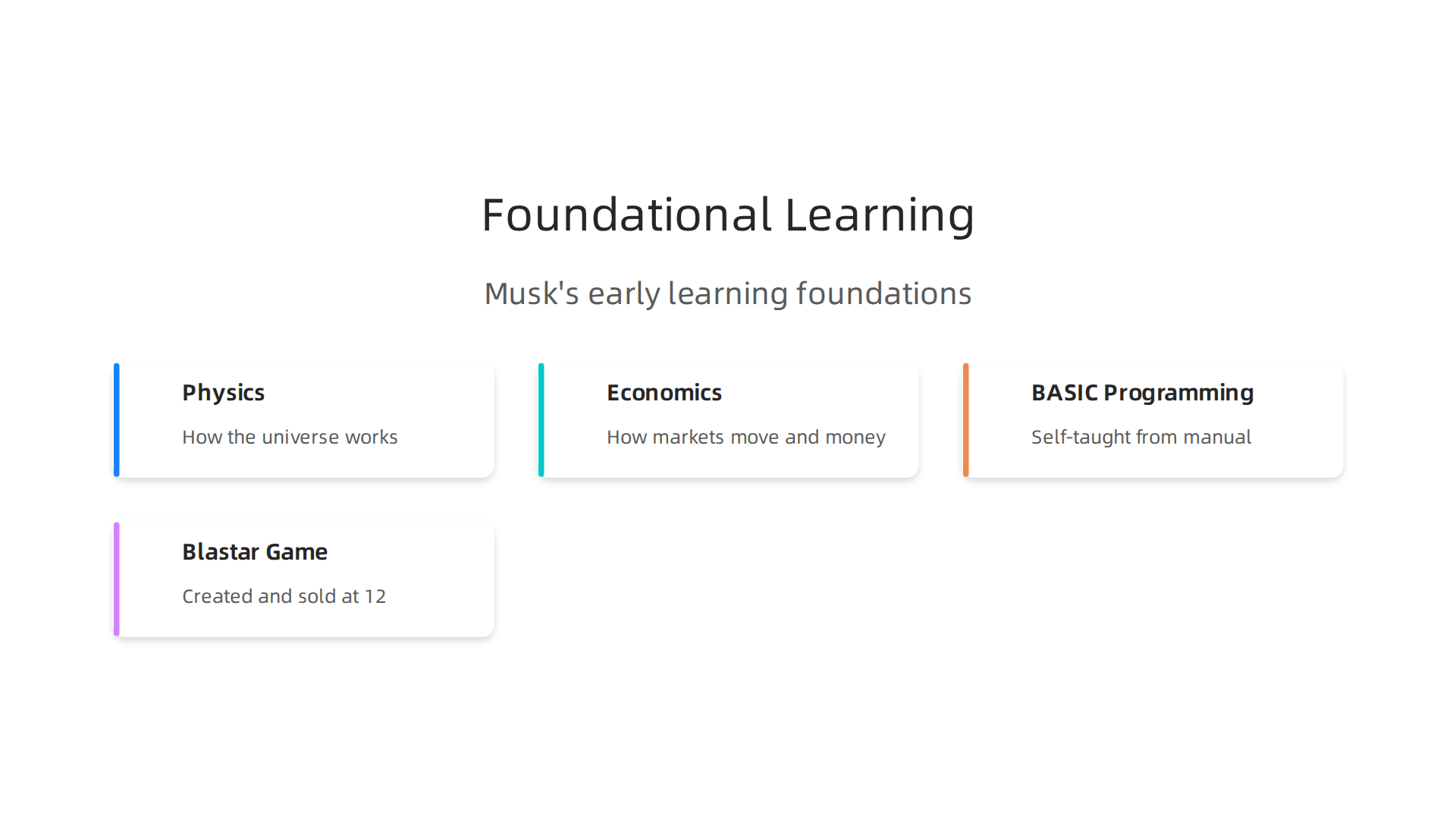
Musk taught himself BASIC programming. He read the manual cover to cover. By age 12, he had created a video game called Blastar. He sold the source code to a magazine for $500. Think about that. A 12-year-old teaching himself to code and making real money from it. That is the kind of self-directed learning that no classroom can replace.
His formal path looked more traditional at first. At 17, he moved to Canada to attend Queen’s University. Then he transferred to the University of Pennsylvania. This is where the real strategy shows up. He did not just pick one subject. According to a detailed account of where Elon Musk went to college, he earned two bachelor’s degrees. One in physics and one in economics.
Think about that combination. Physics teaches you how the universe works at a fundamental level. It trains you to use first principles thinking. Economics teaches you how markets move and how money flows. Together, they are a powerful toolkit for building things that people actually need.
After UPenn, he got into Stanford for a PhD in applied physics. He showed up. He stayed for exactly two days. Then he left to start his first company, Zip2. The internet was taking off and he could not wait.
The takeaway here is simple. Musk did not waste his time in school. He used it to build a broad foundation. He mixed hard science with business knowledge. And he never stopped teaching himself hands-on skills like programming.
This kind of mix is rare. Most schools push you to pick one narrow lane. Musk went wide. That decision helped him build some of the most important types of technology we use today.
2. Zip2, PayPal, and the First Fortunes: Entrepreneurship as Education
After leaving Stanford, Musk jumped straight into building his first company. He and his brother Kimbal founded Zip2 in 1995. The idea was simple. Help local businesses get online with a searchable directory.
Money was tight at first. Their father gave them $28,000 to start. Musk slept in the office and showered at the local YMCA. He wrote most of the code himself.
According to Elon recounting building his first startup Zip2, he wrote the first maps, directions, and yellow pages on the internet. That is a bold claim. But it shows how early he was in the game.
Zip2 did not take off right away. In 1999, Compaq bought the company for $307 million. Musk was 27 years old. His share was $22 million. That was his first big win.
As explained in the story of Elon Musk’s first company, this venture that did not fully succeed still made him a millionaire. That is an unusual sentence to write. But it is true.
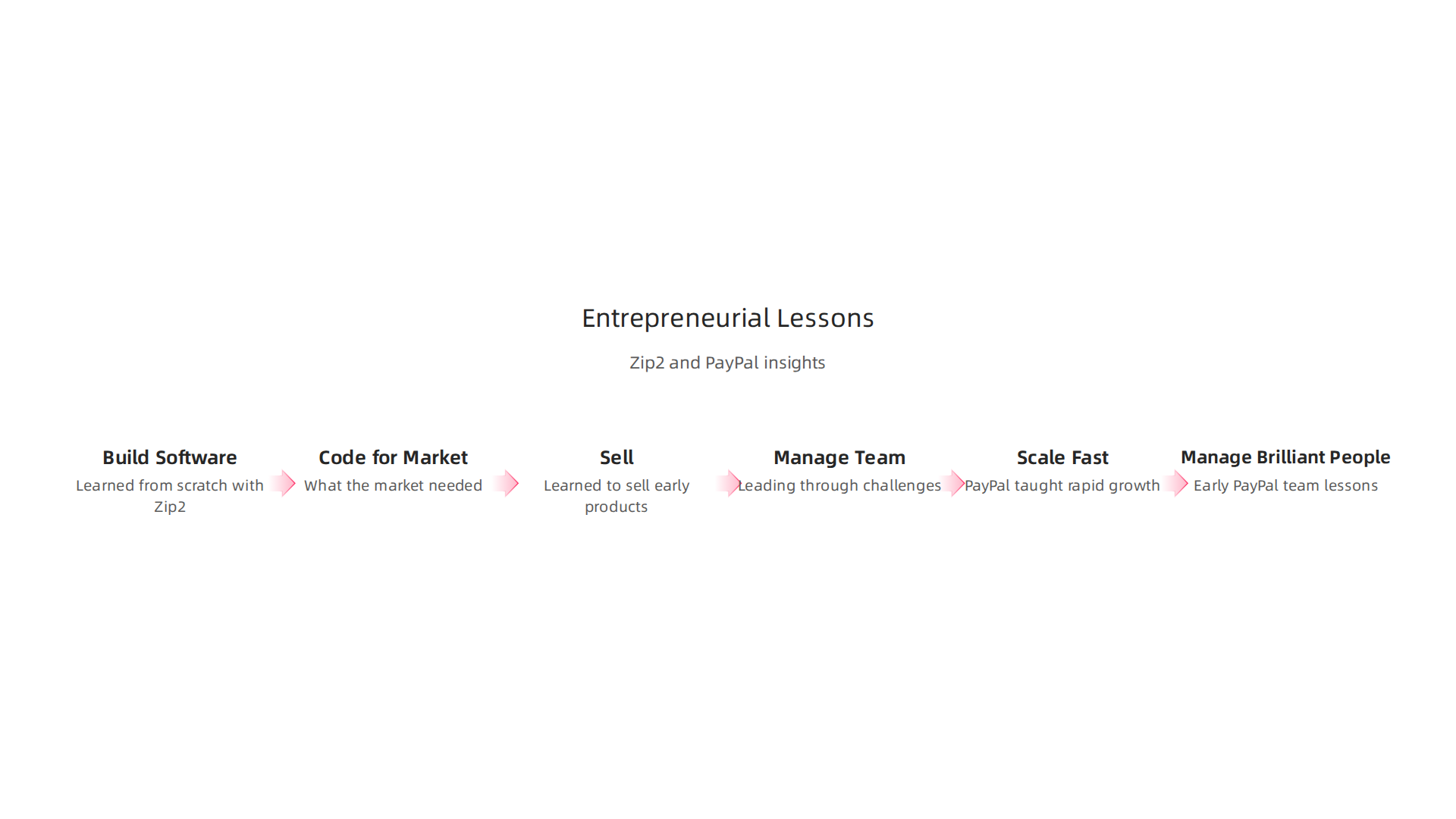
The real lesson? Musk learned how to build software companies from scratch. He learned to code for what the market needed. He learned to sell. He learned to manage a team when things got hard.
Then came X.com.
Musk put $10 million of his own money into starting an online bank. He called it X.com. If the name sounds familiar, that is because it is the same domain he later turned into what we now know as x.com. Musk’s early startup timeline shows how he reinvested his Zip2 earnings right away.
X.com merged with a company called Confinity. They had a product called PayPal. The combined company focused on the money transfer tool. It worked really well. In 2002, eBay bought PayPal for $1.5 billion. Musk got $180 million.
This is where the "PayPal Mafia" comes in. The early team included Peter Thiel, Reid Hoffman, and Steve Chen. They went on to start companies like YouTube, LinkedIn, and Palantir. That group learned from each other. They pushed each other to take bigger risks.
One lesson Musk took from PayPal was that building great technology is useless if nobody uses it. That idea pushed him to think differently.
The PayPal experience taught him how to scale fast. It taught him how to manage brilliant people. And it gave him the money to do something really bold.
With $180 million in his pocket, he was not done. He was just getting started.
Those first two companies were the real MBA for Musk. No classroom could teach what he learned on the ground.
Every AI, Tesla and Neuralink technology he built after that was shaped by those early lessons.
If you want to stay sharp on where AI and technology are heading next, it helps to follow people who have been building for decades. The AI Newsletter Worth Reading covers these kinds of tech trends every day.
3. SpaceX: Rebuilding Aerospace Education from the Ground Up
With $180 million in hand, Elon Musk could have retired for good. Instead, he turned his attention to something far bigger.
In 2002, he started SpaceX. The goal was simple. Make space travel cheap enough so humans could become a multiplanet species. Most people in aerospace thought he was crazy. They had degrees from top schools. They said it could not be done.
But Musk had a different idea about education. He did not care if you had a degree from MIT or Stanford. He cared if you could build a rocket that actually flew.
That is where the story of SpaceX and the unusual path of elon musk education gets interesting. Musk hired people who loved building things. Some were self-taught. Some had dropped out of college. Many had never touched aerospace before.
The company created a unique path for people without traditional aerospace degrees. The SpaceX internship program gives students a chance to work on real flight hardware. Not just coffee runs. Real rockets. Real engines. Real launches.
At the company’s facility in Boca Chica, Texas, called Starbase, the learning never stops. Engineers and interns work side by side on actual launch vehicles. That is the real education. You learn by doing.
Many people in the industry now call Starbase an open-source learning environment. The company hosts tours. It runs community outreach programs. It invites students to see what building rockets actually looks like. You do not need a formal degree to show up and learn.
Because of this, a new pipeline of engineers has formed. They did not get traditional aerospace degrees. They learned at SpaceX. They built hardware. They tested engines. They solved real problems. Now they lead projects at other companies.
This is a huge shift from the old aerospace world. That world was built on degrees, titles, and reputation. SpaceX said none of that matters. What matters is whether your work flies.
The lesson is clear. You can learn software companies by starting one. You can learn engineering by building. The types of technology Musk touches keep growing, but the approach stays the same. Learn fast. Break things. Fix them.
That is the kind of education that cannot be taught from a textbook.
If you want to see how this hands-on approach connects across all of Musk’s companies, take a look at how Elon Musk’s 2026 tech empire works together. It is one giant learning machine.
4. Tesla: Electrifying Engineering Education and the Open Patent Philosophy
SpaceX proved that you do not need a traditional aerospace degree to build rockets. Tesla took that same "learn by doing" mindset and applied it to cars, batteries, and energy. The result is a company that teaches its own engineers from scratch.
Tesla runs several programs that train people without formal engineering backgrounds. One of the best known is the Tesla START program.
It is a partnership with community colleges and technical schools. Students spend weeks in a classroom learning Tesla’s systems. Then they move into real service centers. They work on actual cars. By the end, they have a job offer from Tesla.
The same hands-on approach happens inside Tesla factories. New hires start on the production line. They learn how the whole vehicle goes together. Then they can move into engineering roles. Tesla does not ask for a diploma. It asks if you can build a working part.
This creates a culture where skills matter more than paper. And it is a big part of the elon musk education story. Musk himself says that the best engineers are the ones who tinker, break things, and fix them again.
In 2014, Tesla did something radical. It opened up all of its patents to the public. Anyone could use Tesla’s technology for free. Musk said the goal was to speed up the electric vehicle revolution. It was an educational move. By sharing its designs, Tesla taught the whole industry how to build better EVs.
That move helped create a wave of new software companies and hardware startups. They could learn from Tesla’s work without starting from zero. It is one of the reasons electric cars are so much better today.
Tesla’s vertical integration also forces engineers to learn across many types of technology. A Tesla engineer needs to understand batteries, electric motors, software code, and even how the car talks to the grid. That is rare in the auto industry. Most car makers have separate teams for each part. Tesla wants one person who can connect everything.
This cross-disciplinary skill set is exactly what the modern tech world demands. It is not about being the best at one thing. It is about understanding how all the pieces fit together.
If you want to stay on top of how companies like Tesla are changing the game, a quick daily read can help. Check out The AI Newsletter Worth Reading for clear updates on the tech that is reshaping education and work.
And for a deeper look at how all of Musk’s companies connect through shared technology, this article on Elon Musk AI and Tesla convergence shows the bigger picture.
5. Neuralink, The Boring Company, and xAI: Ventures That Define New Skill Sets
Tesla and SpaceX showed the world that you can learn complex engineering without a degree. But Musk’s newer companies take that idea even further. They are building industries that did not exist before. And that means there is no school for them.
Think about brain-computer interfaces. Neuralink is trying to connect human brains directly to computers. No university has a degree program for that. So Neuralink has to train its own people.
The company looks for unusual combinations of skills. You might be a neurosurgeon who also knows how to write code. Or you might be a roboticist who has never worked on medical devices. Neuralink’s careers page says it clearly. You do not have to be a brain surgeon to work there. They need people from all backgrounds.
This is the heart of the elon musk education philosophy. He does not want specialists who only know one thing. He wants people who can learn new types of technology quickly.

A Neuralink software engineer needs to understand biology. A tunnel engineer at The Boring Company needs to understand how to build ventilation systems. These are not skills you find in a textbook.
The Boring Company is another great example. It digs tunnels faster and cheaper than anyone else. There is no degree in tunnel boring that teaches you how to do that. So the company creates its own learning on the job. You start by learning how the machines work. Then you figure out how to make them work better.
xAI, Musk’s artificial intelligence company, takes a similar approach. The company’s mission is to understand the true nature of the universe. That is a big goal. And it requires people who are curious above all else. xAI looks for engineers who ask big questions. It wants people who build things just to see if they can work.
A lot of the early discussion about xAI happened on platforms like x.com elon musk and reddit tech. People debated whether the company could compete with OpenAI and Google. But the real lesson is about learning. xAI did not hire people with AI degrees. It hired people who had built interesting software companies or worked on weird projects. The key trait was a willingness to learn from scratch.
If you look across all of Musk’s ventures, a pattern appears. Every company builds its own educational pipeline. They teach skills that no school offers. And they hire people based on potential, not past experience.
Want to see how all of these companies connect through shared technology and shared learning? This breakdown of the Elon Musk interconnected tech empire shows the bigger picture.
6. The Musk Method: Self‑Learning, First Principles, and a High Tolerance for Failure
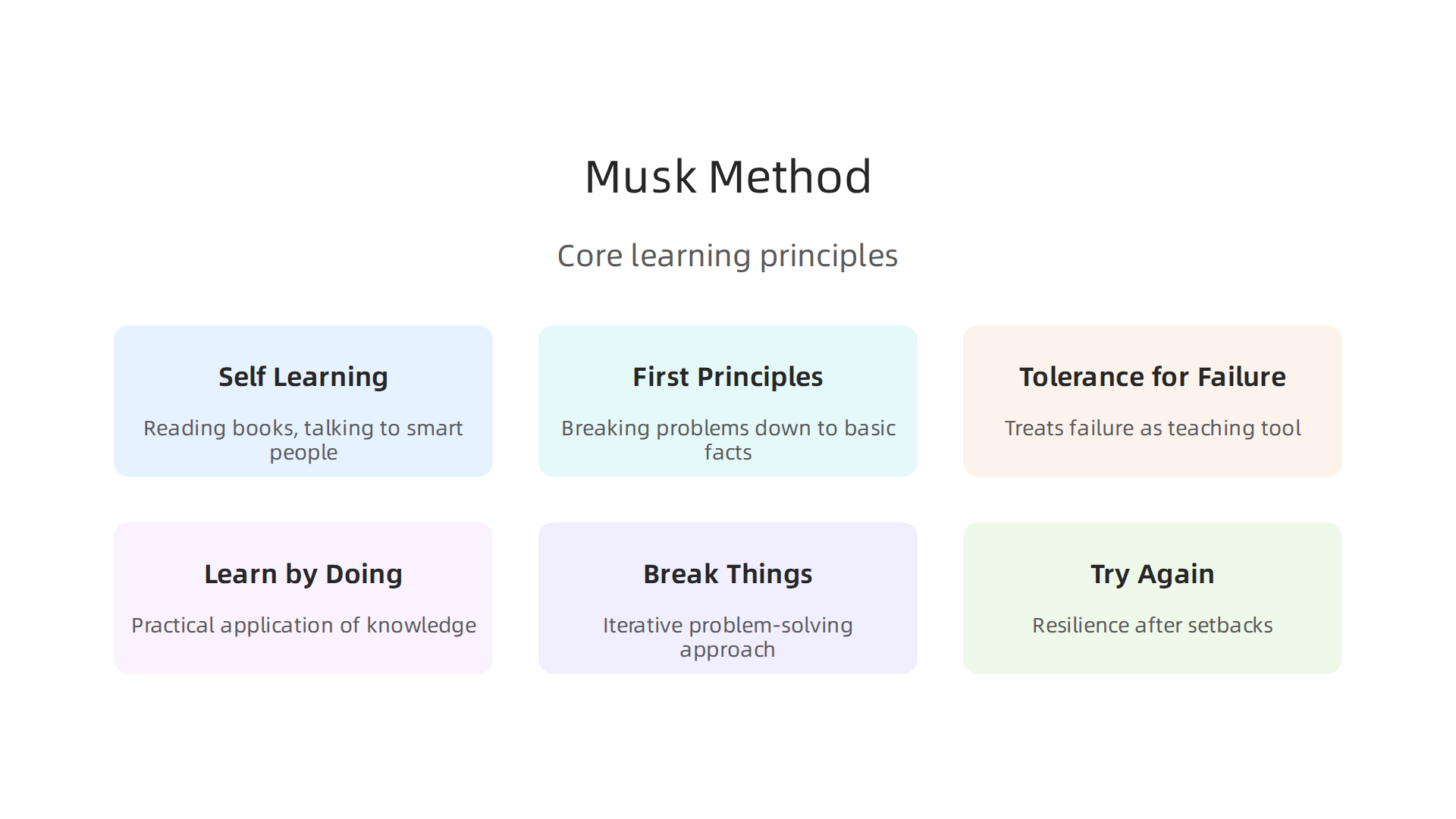
People often ask what makes Elon Musk different. His answer is simpler than you might think. He has said for years that the best way to learn is to read books and talk to smart people. He explains why a college degree is not required if you have curiosity and drive. That is the whole method. No expensive degree needed. He learned rocket science by reading textbooks and asking engineers questions. He learned car manufacturing by sleeping on the factory floor.
This is exactly the kind of advice you see discussed in conversations on x.com elon musk and reddit tech. People debate whether formal education still matters these days. Musk’s own actions give a clear answer.
The real secret is first-principles thinking. This means breaking a problem down to its most basic facts. Then you rebuild the solution from scratch. You do not copy what others have done before. You ask what is actually true about the physics, the materials, and the costs involved.
Schools across the country now teach first-principles thinking in STEM classes. But Musk has been using this approach for decades. It works whether you are building rockets or starting new software companies.
Here is the part that does not get enough attention. First-principles thinking only works if you can handle failure. And Musk has failed in big public ways.
SpaceX crashed its first three rockets before one finally worked. The company almost went bankrupt. Tesla went through production hell where cars would not come off the line on schedule. Employees slept on the factory floor. Money was running out fast.
Most people would have quit by then. But Musk treats failure as a teaching tool instead. Every crash taught the SpaceX team something new about rocket design.

Every delay at Tesla taught the company how to build cars faster and more reliably.
This is the core lesson of the elon musk education method. You learn by doing. You learn by breaking things. And you learn by trying again, no matter how many times you fail first.
If you want to follow how all of these types of technology connect, keeping up with daily AI and tech news helps. You can learn about how xAI, Tesla, and Neuralink converge in 2026 to see the bigger picture behind Musk’s ventures. And for clear daily updates on what is happening across AI and tech, The AI Newsletter Worth Reading gives you a quick, useful start to your day.
Summary
Elon Musk’s educational path blends formal degrees with intense self‑directed learning and on‑the‑job training, showing that traditional schooling is only one route to major technological impact. The article traces his childhood curiosity, dual bachelor’s in physics and economics, and his two‑day stint at Stanford before leaving to found startups. It explains how Zip2 and PayPal taught him product, scaling, and team leadership, and how SpaceX and Tesla turned hiring and internal programs into practical training grounds for engineers without conventional degrees. The piece also covers newer ventures—Neuralink, The Boring Company, and xAI—that create their own skill requirements and force companies to train people from scratch. Across all of it, Musk’s approach emphasizes first‑principles thinking, relentless self‑study, learning by doing, and treating failure as feedback. After reading, you’ll understand how his mix of formal learning, DIY skill‑building, and company‑level training produces engineers and teams who can build previously impossible technologies, and how you can apply those same habits to your own learning and career.