Introduction
You open your phone in the morning, and there it is again. Another headline about Elon Musk. Maybe it is a new robot update from Tesla. Maybe it is a bold prediction about artificial intelligence. Or maybe it is a surprise merger that reshapes an entire industry. The news cycle around Elon Musk moves so fast that it can feel impossible to keep up.
Here is the thing. A lot of what you see is noise. Every announcement gets huge attention from the media. But not every update actually matters for your life or your work. Some of these developments are real breakthroughs. Others are just hype. The challenge is figuring out which is which.
That is where this article comes in. We are cutting through the flood of elon musk news to give you the signal, not the noise. We focus on the most important developments from 2026 so far. That includes major moves from xAI, Tesla, and Neuralink. We also look at the bigger picture: how elon musk ai projects are connecting in ways that are easy to miss.
Some of these connections feel like invisible technologies at first. You do not see them directly. But they are quietly reshaping how cars drive, how robots learn, and how computers think. The technology trigger for this shift is already happening. Tesla just invested $2 billion into xAI, as covered in the Tesla’s $2 billion investment into xAI report. That is not a small move. It is a sign that Musk is building something much bigger than any single product.
We wrote this for people like you. Tech enthusiasts, product managers, marketers, and professionals who want to understand what these changes actually mean. You do not need to read every tweet or press release. You just need the right analysis at the right time.
By the end of this article, you will have a clear picture of where Musk’s AI strategy is heading in 2026 and how it could affect your workflow, your buying decisions, and your understanding of the future. If you want to stay ahead of these trends without the daily clutter, check out The AI Newsletter Worth Reading. It delivers clear daily AI updates straight to your inbox.
Let us start with the biggest story of the year: the quiet consolidation of Musk’s entire AI empire and what it means for the rest of us.
xAI and Grok: The Evolution of a Conversational Powerhouse
That $2 billion investment from Tesla into xAI is not just about cash. It is about data. And data is the fuel that powers Grok, xAI’s chatbot that keeps getting smarter by the day.
Here is what makes Grok different from every other AI assistant.
It lives inside the X platform. That gives it access to real time conversations happening right now. When a story breaks on X, Grok sees it instantly. Other models need to wait for search engines to crawl and index. Grok does not wait. This real time data feed is its biggest advantage in 2026.
But raw data alone is not enough. You need a powerful engine to make sense of it all.
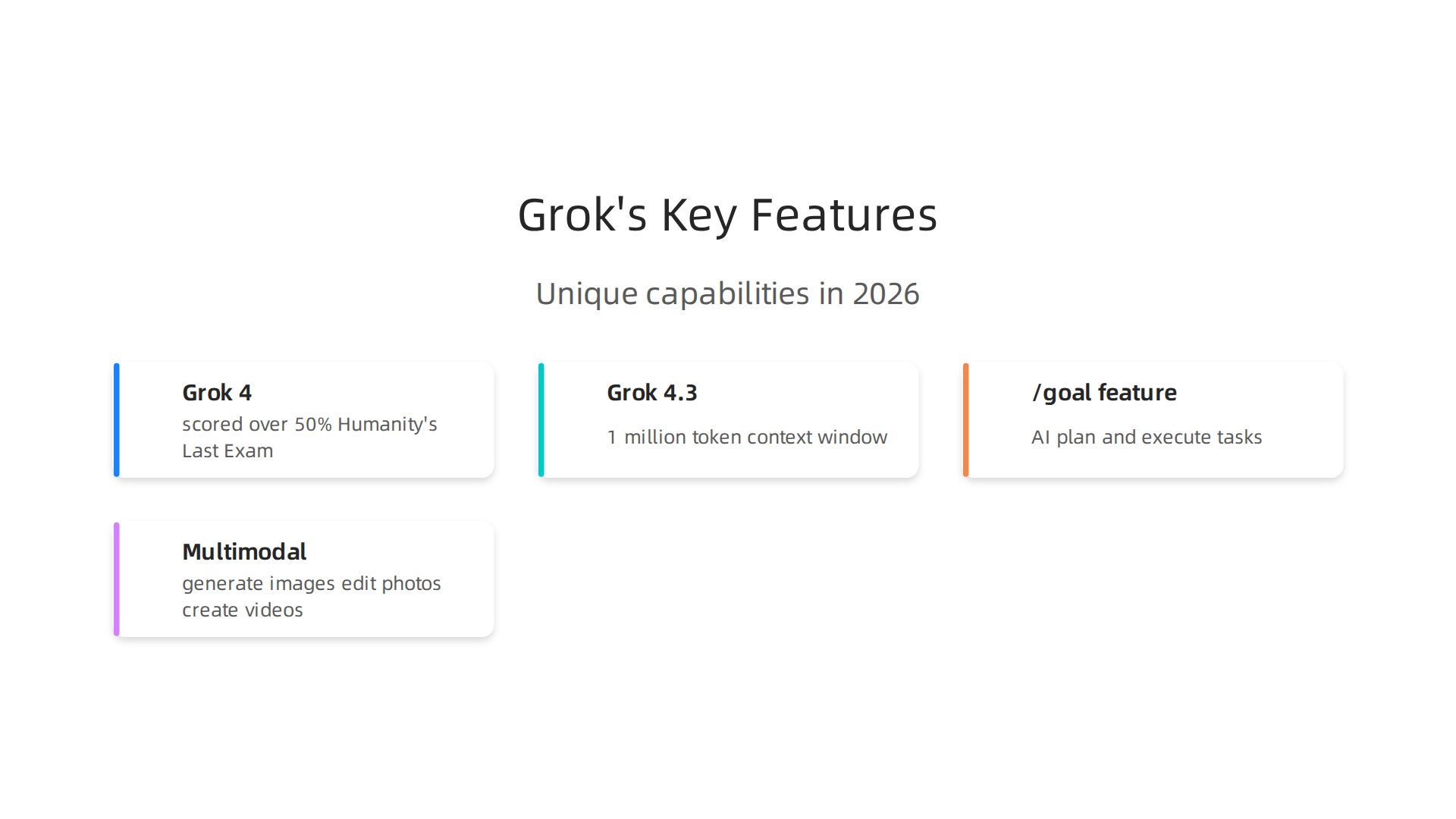
That is where the Grok model lineup comes in. Grok 4 launched in early 2026 as a huge leap forward. According to the Grok 4 official announcement, it became the first model to score over 50% on Humanity’s Last Exam. That benchmark was designed to be the final closed ended academic test for AI. Hitting that mark puts xAI in the same league as OpenAI and Google.
The upgrades kept coming. Later in 2026, Grok 4.3 arrived on Amazon Bedrock with a 1 million token context window. That is big enough to handle entire codebases or long legal contracts in a single request. xAI also introduced the /goal feature in Grok Build, which lets the AI plan and execute tasks on its own without you watching every step.
Multimodal abilities are another area where Grok shines. You can generate images, edit photos, create short videos, and use voice commands. Voice mode on mobile is five times faster than typing, which makes a real difference when you are on the go. The Grok Imagine API lets developers edit images using plain language commands.
For coding, xAI shipped dedicated models like grok-code-fast-1 that work inside popular IDEs. The Grok 4.20 multi agent architecture runs four separate reasoning agents at the same time, each handling a different part of a complex problem.
So how does xAI stack up against the big players? OpenAI still has the biggest brand name. Google has massive cloud infrastructure. Anthropic focuses on safety first. But xAI owns something none of them can match: direct access to one of the largest real time social platforms on earth. That is a competitive moat that only gets deeper.
Want to see how all the pieces of Musk’s ecosystem fit together? Our full analysis on Musk’s interconnected tech empire shows how xAI, Tesla, and Neuralink are becoming one tightly woven machine.
Tesla’s AI Push: Full Self-Driving, Optimus, and Beyond
While xAI focuses on language and social data, Tesla is pushing AI into the physical world. Self-driving cars, humanoid robots, and massive supercomputers are all pieces of the same puzzle. And in 2026, each piece is moving faster than ever.
Full Self-Driving Hits Version 14.3.4
The biggest Tesla AI story right now is FSD v14.3.4. This update started rolling out in June 2026 to Hardware 4 vehicles in North America. It is a minor point release, but the changes are significant.
Tesla rewrote the AI compiler and runtime from the ground up, improving reaction time by 20%. The neural network vision encoder got a major upgrade, helping the car understand rare and low-visibility scenarios better. Tesla also upgraded the reinforcement learning stage, which improves decision-making across a wide range of driving situations.
One feature that stands out is Actually Smart Summon coming to the Cybertruck for the first time. You can now walk away from your Cybertruck in a parking lot and have it find a spot and park itself. The full release notes are available in the FSD 14.3.4 release notes from Not a Tesla App.
Beyond the US, Tesla is rolling out FSD v14.2.2.6 in Europe. Regulatory approvals are coming step by step, and each new market opens a fresh wave of real-world data for training.
Optimus and Dojo: The Other Pieces
Tesla’s Optimus humanoid robot is no longer a lab experiment. In 2026, it entered beta testing inside Tesla factories. The robot is performing real tasks like moving parts and sorting bins. This is exactly the kind of invisible technology that most people never see but that quietly reshapes manufacturing. Optimus uses the same AI brain as the Full Self-Driving system, but trained for physical manipulation instead of driving.
Behind all this sits the Dojo supercomputer. Tesla designed Dojo from scratch to train its massive neural networks. The latest updates have increased its capacity to handle the enormous datasets coming from millions of vehicles and robots. Dojo is the technology trigger that makes everything else possible, an invisible powerhouse that runs 24/7.
For the latest elon musk news, every Tesla AI milestone is worth watching. The line between what a car, a robot, and a virtual assistant can do is blurring fast. If you want to stay on top of every AI development from Tesla and beyond, consider subscribing to the The Deep View Newsletter for clear daily updates.
Neuralink: Brain-Computer Interfaces Move Closer to Mainstream
While Tesla works on AI that drives cars and runs robots, Neuralink is building a direct link between the human brain and computers. In 2026, this technology is moving out of science fiction and into real medical treatment faster than most people realize.
21 Patients and Growing
As of January 2026, Neuralink has enrolled 21 participants enrolled in Neuralink trials worldwide. That is up from 12 just a few months earlier. The first patient, Nolan, received his implant in early 2024 and still uses it daily to browse the web, play video games, and control a laptop cursor with his thoughts.

He does all this despite the fact that about 80 percent of the original electrodes in his implant retracted over time.
That early problem led to a major redesign. Later patients received implants with about double the electrode density. Reports suggest the thread retraction issue is now largely solved. The second patient, implanted in mid-2024, had 400 electrodes working from day one.
New Trials for Speech and Sight
The biggest news in 2026 is how Neuralink is expanding beyond basic cursor control. The company now runs multiple active clinical trials. The VOICE trial helps people who cannot speak due to ALS, stroke, or spinal cord injury. An implant in the speech motor cortex decodes brain signals directly into words. An AI platform called ElevenLabs then speaks those words in the user’s own voice.
Then there is the vision restoration effort. Neuralink’s Neuralink clinical trials page lists an upcoming study for people with severe vision impairment. The goal is to send visual signals straight to the brain, bypassing damaged eyes. If this works, it could restore sight for people who have been blind for years.
What Comes Next
Neuralink raised $650 million in early 2026 to scale production and expand clinical work. Regulatory approvals are spreading too. The FDA has cleared US trials, and the company now has patients in Canada and the UK. A UK patient named John shared a one-month update showing smooth recovery and good implant function.
For anyone following elon musk ai developments, Neuralink is the most direct example of human-machine integration yet. It is still early, but the direction is clear. Brain-computer interfaces are moving from experimental labs into the hands of people who need them most. To see how all of Musk’s technology companies fit together, read this overview of Musk’s interconnected tech empire.
The Convergence of Musk’s AI Ventures: Synergies and Strategic Risks
Neuralink connects brains to computers, but the real story in 2026 is how all of Musk’s AI companies are starting to work together. Each company builds a piece of the same puzzle. When you step back, you see a system where data, intelligence, and hardware flow between Tesla, xAI (now part of SpaceX), Neuralink, and X. The latest elon musk news shows this convergence is accelerating faster than many expected.
How xAI’s Models Could Power Tesla and Optimus
The most concrete example is money. In January 2026, Tesla invested $2 billion into xAI.
According to a detailed report, this Tesla $2 billion investment in xAI is part of "Master Plan Part IV." The goal is simple: give Tesla’s cars and Optimus robots the best digital brain available. xAI’s Grok language model could one day understand voice commands, predict driver intent, and help Optimus navigate messy real-world spaces. Tesla already has the hardware. xAI brings the reasoning power to make that hardware truly smart.
Then, in May 2026, Musk dissolved xAI as a separate company and folded it into SpaceX under the name SpaceXAI. This xAI to SpaceXAI integration means all AI work now shares a single infrastructure. That includes the massive Colossus supercomputer with over 220,000 Nvidia GPUs. Instead of building separate models for each company, SpaceXAI trains one powerful system that can run inside a Tesla, a Starlink satellite, or a Neuralink implant. This is what experts call a technology trigger a moment when separate pieces lock together into something much bigger.
Data Sharing Between Tesla and Neuralink
Here is a surprising possibility. Tesla’s fleet of millions of cars collects enormous amounts of real-world driving data. Neuralink meanwhile records detailed brain signals from trial participants. Combining these two data sets could help build better brain-computer interfaces. For example, if a Neuralink user thinks about moving their hand, that pattern could help train Tesla’s AI to predict human actions more accurately. And Tesla’s driving data could help Neuralink understand how the brain controls complex movement.
This kind of cross-company data flow is one of those invisible technologies that most people never see. You will not find it listed on a spec sheet. But it may be the most valuable part of Musk’s strategy. According to an analysis of the entire ecosystem, each company strengthens the others in ways that are hard to replicate. Read more about how Musk’s AI ecosystem connects xAI, Tesla, Neuralink, and SpaceX.
Regulatory and Antitrust Concerns
The biggest risk of this convergence is that regulators may not like it. When one person controls a car company, a brain implant company, an AI company, and a satellite network, the power is enormous. Antitrust authorities in the US, Europe, and the UK are watching closely. If Tesla and Neuralink share data without clear consent rules, privacy violations could trigger massive fines.
There is also a subtler risk. If all of Musk’s AI runs on the same system, a failure in one place could ripple everywhere. A bug in Grok could affect how Optimus moves or how a Neuralink user speaks. This is why some experts argue for more separation between the companies. But for now, Musk is betting that integration creates more value than independence.
A Personal Next Step
This convergence is moving fast. New developments in elon musk ai happen almost weekly. If you want to keep up without spending hours scrolling through news feeds, there is a simple way. Get clear daily AI updates from The Deep View Newsletter. It cuts through the noise and gives you the real story behind the headlines.
In the next section, we will look at how Musk’s energy business ties all of this together and why power may be the most important resource of all.
Impact on Consumer Tech: New Gadgets, Software, and Daily Workflows
Before we dig deeper into the energy side, let us look at something more immediate. The convergence of Musk’s AI companies is already changing the gadgets and software you use every day. In 2026, the effects show up in three big areas: smart homes, productivity tools, and wearable devices. This is where the latest elon musk news stops being abstract and starts affecting how you live and work.
Smart Home Integrations with Grok and Tesla Energy AI
The smart home is getting a serious upgrade. Tesla Energy AI already manages your home’s power use through the Powerwall and solar panels. Now Grok is joining the conversation. Imagine telling a single voice assistant to adjust your thermostat, check your car’s battery level, and generate a short video from your security camera feed, all in one sentence.
Grok now supports agentic tasks that run in the background for long periods. It can plan energy usage for the week, adjust settings based on your calendar, and pull live data from your Tesla to predict charging needs. The full list of Grok agentic features and updates shows just how deep this integration goes. This is a real technology trigger for the smart home industry.
Productivity Tools Leveraging xAI APIs for Professionals
For professionals, the biggest change is invisible but powerful. xAI now offers APIs that let developers build Grok’s intelligence into any app. Image editing through natural language, video generation, and real-time web search are all available at low cost. For example, Grok’s image editing and generation capabilities work through simple text commands at prices starting from two cents per image.
What does this mean for your daily workflow? Your project management tool may soon include a Grok agent that summarizes meetings, creates slide decks, and searches live data without you leaving the app. This is one of those invisible technologies that quietly makes your workflow faster. You do not need to learn a new tool. The AI just works inside the apps you already use.
Wearables and Brain Interfaces for Creators and Early Adopters
The most futuristic category is wearables. Neuralink’s brain-computer interface is still in early trials, but creators and early adopters are watching closely. The idea is that one day you could generate images or control software just by thinking about it. Combined with xAI’s advanced reasoning models like Grok 4, which scores at the top of benchmark tests for logical reasoning and agentic tasks, the potential for creative work is massive.
For now, the practical application is simpler. Grok works on your phone with voice mode, dictation, and real-time image generation. It is available on iOS and Android. You can create a 6-second video in about 25 seconds with the latest Grok Imagine Video 1.5 Fast model. That is a real productivity gain for content creators today.
To see how all of Musk’s companies connect into one system, check out how Musk’s 2026 tech empire is more interconnected than ever. It puts these consumer pieces into the bigger picture.
Privacy, Ethics, and Regulation: Navigating the Musk AI Landscape
With all this power concentrated in Musk’s companies, big questions start to surface.
Your privacy, the ethics of brain implants, and the laws trying to keep up all matter right now. Let us walk through what you should know about the elon musk news that goes beyond gadgets and into real risks.
Data Privacy Concerns with Grok
Grok pulls data directly from X (formerly Twitter). That means your public posts, likes, and even direct messages if you are a premium user can feed into its AI training. In early 2026, the Maryland Attorney General sent a detailed letter to xAI demanding changes. The letter called out Grok for producing nonconsensual images and asked for stronger controls so users can stop the AI from editing their photos.
This is not just a theoretical worry. If you use X or any app that connects to Grok, your data is part of this system. The good news is that xAI responded with plans to give users more control. Still, it pays to check your privacy settings regularly and think twice before sharing personal content on platforms where AI is watching.
Ethical Debates Around Neuralink
Neuralink’s human trials are moving fast. By January 2026, the company had 21 participants enrolled worldwide according to a Reuters report. The first patient uses the implant to play video games and control a computer with his mind. That sounds amazing, and it is.
But some experts are uneasy. A STAT News article pointed out that Neuralink’s public talk about merging humans with AI goes far beyond what the current medical trials actually do. The company talks about transhumanism while doctors focus on helping paralyzed people move cursors. This gap creates confusion about what the technology really offers. Meanwhile, scientists interviewed by Nature raised concerns about a lack of transparency around the implant’s performance and safety data.
Neuralink says it is working with regulators and has seen no major device-related problems in its trials. Still, the ethical conversation will only grow louder as more people get the implant.
Regulatory Actions Across the US and EU
Governments are not waiting. In the United States, a patchwork of state laws took effect in 2026. California’s SB 53 requires frontier AI developers like xAI to publish risk frameworks and implement whistleblower protections. Colorado’s AI Act requires risk management for high-risk systems. Texas passed its own Responsible AI Governance Act.
At the federal level, the White House issued a new executive order in June 2026 focused on promoting advanced AI innovation and security. It calls for a voluntary framework where AI developers can share frontier models with the government for safety checks before release. This is a careful balance between encouraging innovation and protecting national security.
Across the Atlantic, the European Union’s AI Act is moving toward full enforcement. The transparency rules come into effect in August 2026. They require clear labeling of AI-generated content, including deepfakes and public interest text. Companies like xAI will need to comply if they operate in the EU.
Staying Informed in a Fast Moving Landscape
With new laws, ethical debates, and privacy concerns changing almost monthly, the best way to stay safe is to keep learning. You can start by reading a data-driven analysis of safety risks in the broader tech world. It helps you understand how these same patterns play out across platforms.
If you want to keep up with AI regulation, privacy updates, and ethical tech news without spending hours scrolling, try The AI Newsletter Worth Reading. It delivers daily updates straight to your inbox so you never miss a regulation change or a major shift in the industry.
Summary
This article cuts through the nonstop Elon Musk headlines to show what really matters in 2026: xAI’s Grok advances, Tesla’s push to put AI into cars and robots, and Neuralink’s clinical progress linking brains to machines. It explains Grok’s edge from live X data, the technical leaps in Grok 4.x and long‑context APIs, and how Tesla’s FSD v14.3.4, Optimus robots, and Dojo supercomputing work together. The piece lays out Neuralink’s growing trial cohort and new speech and vision studies, then connects the dots on cross‑company data flows, business synergies, and regulatory risks. You’ll learn how these developments may change smart homes, productivity tools, and wearable workflows, what safety and privacy questions to watch, and practical signals to follow so you can separate hype from meaningful change.